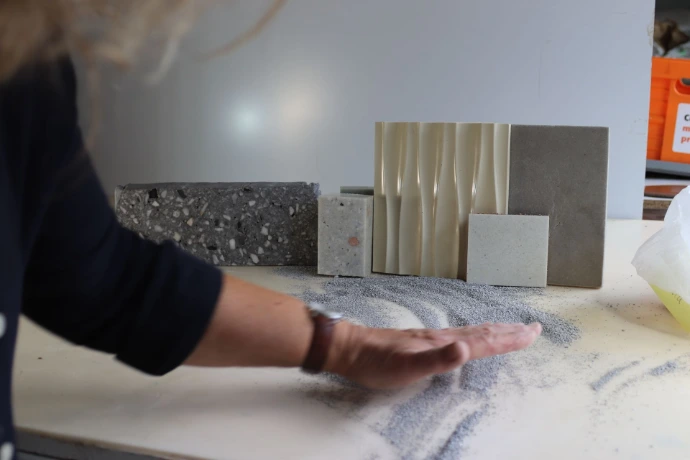
OriBond is a two-component system based on plants. Component A is a resin made from epoxidised linseed oil. Component B is a patented hardener made from plant-based acids and esters. Together they form a thermosetting binder that binds your filler or fibre into a solid material.
The system is water-free and, once cured, water-resistant in cold and in boiling water. Cured OriBond resists to most chemicals, from acids to aromatic hydrocarbons and most organic solvents. Only strongly alkaline environments affect it.
Cured OriBond is not persistent in the environment. When ground, it is biodegradable in soil and re-enters the natural carbon cycle.
Carbon we borrow
Plants take carbon from the air and turn it into more complex carbon compounds. We borrow carbon compounds from plants, process them into a binder and return them to the biogenic carbon cycle after use. When finely ground, cured OriBond will be digested by soil microbes.

Flexible or stiff, you choose the profile
The character of the cured material depends on combinations or resin and hardener. Both systems share the same plant-based base and the same sustainability features.
They differ in hardness, strength and elongation.
| Property | Flexible system | Stiff system |
|---|---|---|
| Hardener (provisional code) | T-range | E-range |
| Character | flexible to semi-rigid, slightly resilient | semi-rigid to rigid, higher strength |
| Shore D hardness | 24 to 58 | 45 to 75 |
| Tensile strength | 3 to 10 MPa | 12 to 30 MPa |
| Elongation at break | 40 to 70% | 15 to 50% |
| Glass transition temperature (Tg) | 30 to 65 °C | 40 to 75 °C |
| Mix ratio resin to hardener (rounded figures) | 2 : 1 (on weight base) | 3 : 1 (on weight base) |
Test methods: Shore D according to ASTM D2240, tensile strength and elongation according to ASTM D638 or ISO 527, Tg according to ASTM D3418. The values are guide values that vary with the curing process.
What both systems share
Density after curing
1.1 to 1.15 g/cm³ according to ASTM D792.
Water absorption
0.5 to 1.5% after 24 hours at 23 °C according to ASTM D570.
Volume swelling in water
Below 1% when heat-cured.Biogenic carbon
100% according to ASTM D6866.
VOC
Below 1% according to EN 16516.
Biodegradability
Biodegradable in soil according to ISO 17556.
Three ways to cure
OriBond cures at room temperature or with heat, with or without pressure. That makes it suitable for casting, moulds, cold pressing and hot pressing. You choose the profile that fits your line.
| Room temperature | Oven | Hot press | |
|---|---|---|---|
| Temperature | 20 to 25 °C | 90 to 180 °C | 100 to 180 °C |
| Curing time (*) | 24 to 72 hours | 30 to under 5 minutes | 15 to under 5 minutes |
(* Results obtained with pure OriBond. Curing time can be significantly reduced by using proper (safe) additives.)

Your material,
Our binder
Do you want to know which system fits your filler or fibre and your process? We determine that together with you.
How can we help?
Send us a message
Call us
Contact us anytime
Philippe Willems
phw@orineo.com
(+32) 475 801 602
Rian Jacobs
rj@orineo.com
(+31) 6 34 08 23 15